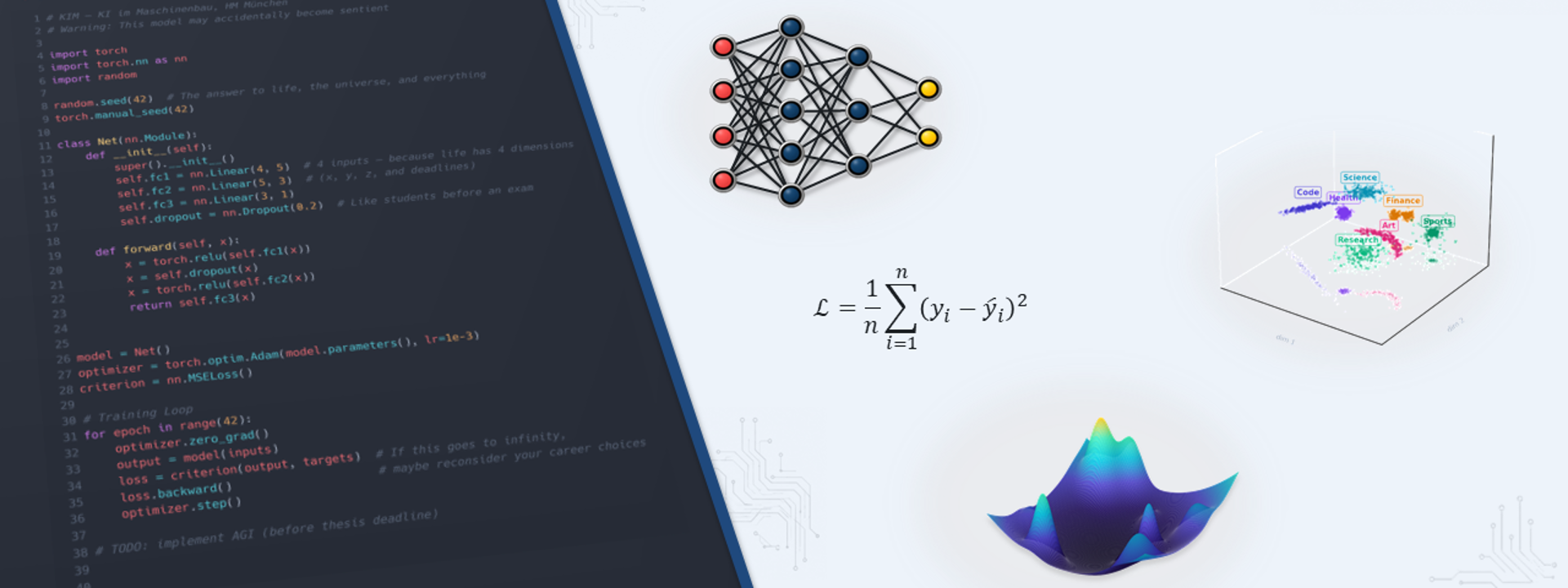
Artificial Intelligence in Mechanical Engineering
The KIM research group at Munich University of Applied Sciences bridges mechanical engineering expertise with state-of-the-art AI methods – directly in tune with industry needs.
We develop data-driven solutions across the full product lifecycle: from simulation to test bench to field operation.
KIM Overview
Explore our current research projects, get to know the team, and find out how KIM can advance your business or your studies.
What Distinguishes Us:
Holistic Data Analytics:
We integrate sensor, test bench, process, and field data with simulation results into a coherent data picture – creating the foundation for well-informed, real-time decisions.
Tailored AI Methods:
Our network of researchers, students, and industry partners combines expertise in mechanical engineering, automotive engineering, manufacturing, computer science, and statistics – solving problems no single discipline could tackle alone..
Interdisciplinary Team:
You bring your data, equipment, and questions – we provide the methodological foundation and experimental infrastructure. The result: shorter development cycles, higher quality, and reduced resource consumption.
Research Focus Areas:
Condition Monitoring – Condition monitoring and predictive maintenance of technical systems across their entire lifecycle.
Angewandte KI – Development and validation of data-driven models for process optimization and precise predictions: from classical ML approaches and deep learning architectures to generative and self-learning methods.
Datenvorbereitung & Feature Engineering – Building robust pipelines for data cleaning, synchronization, and feature extraction; an essential foundation for reproducible analyses and high-performance AI models.
Technische Statistik – Proven analysis and forecasting methods as a solid foundation for interpreting complex industrial datasets, particularly in scenarios with limited data availability.
Why KIM?
You bring your data, equipment, and questions – we provide the methodological foundation and experimental infrastructure. The result: shorter development cycles, higher quality, and reduced resource consumption.
As a student at KIM, you conduct research at eye level with industry – working with real datasets, modern hardware, and in direct exchange with experienced researchers.